
Understanding the New U.S. Visa Bond Requirements
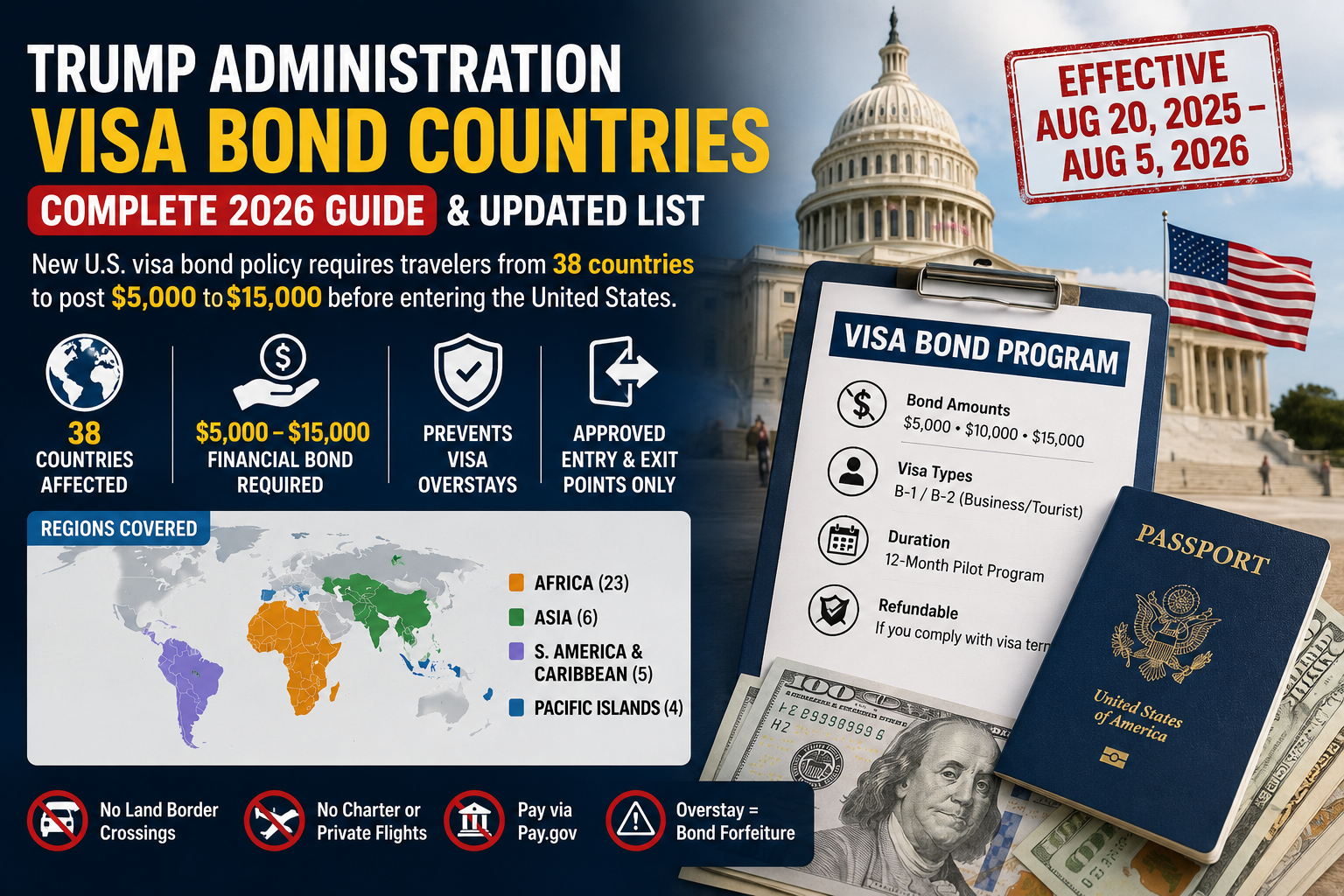
The Trump administration has significantly expanded its visa bond program, now requiring travelers from 38 countries to post financial bonds ranging from $5,000 to $15,000 before entering the United States. This comprehensive guide breaks down everything you need to know about the visa bond policy, affected countries, and what it means for international travel.
What Are Visa Bonds Under the Trump Administration?
Visa bonds are refundable financial deposits that certain foreign nationals must pay when applying for B-1 (business) or B-2 (tourist) visas to enter the United States. The Trump administration launched this pilot program in August 2025 as part of broader immigration enforcement measures.
The program targets countries identified as having high visa overstay rates, deficient screening and vetting procedures, or those offering citizenship by investment programs without residency requirements.
Key Features of the Visa Bond Program:
- Bond amounts: $5,000, $10,000, or $15,000 (determined during visa interview)
- Visa types affected: B-1/B-2 (business and tourist visas only)
- Duration: 12-month pilot program (effective August 20, 2025 until August 5, 2026)
- Refund policy: Bonds are returned if visa is denied or traveler complies with visa terms
Complete List of 38 Countries Subject to Visa Bonds
As of January 2026, the following countries are on the visa bond list:
African Countries (23):
- Algeria
- Angola
- Benin
- Botswana
- Burundi
- Cape Verde
- Central African Republic
- Djibouti
- Gabon
- Gambia
- Guinea
- Guinea-Bissau
- Ivory Coast
- Malawi
- Mauritania
- Namibia
- Nigeria
- São Tomé and Príncipe
- Senegal
- Tanzania
- Togo
- Uganda
- Zambia
- Zimbabwe
Asian Countries (6):
- Bangladesh
- Bhutan
- Kyrgyzstan
- Nepal
- Tajikistan
- Turkmenistan
South American & Caribbean Countries (5):
- Antigua and Barbuda
- Cuba
- Dominica
- Venezuela
Pacific Island Countries (4):
- Fiji
- Tonga
- Tuvalu
- Vanuatu
Implementation Date: Most recently added countries' requirements took effect on January 21, 2026.
How the Visa Bond System Works
Application Process
- Visa Interview: Applicants must attend an in-person interview at a U.S. embassy or consulate
- Bond Assessment: Consular officers determine the bond amount ($5,000, $10,000, or $15,000)
- Payment: If directed, applicants pay through the Department of Treasury's Pay.gov platform
- Form Submission: Complete Department of Homeland Security Form I-352
- Visa Issuance: Bond payment does not guarantee visa approval
Entry and Exit Requirements
Travelers who post visa bonds face strict entry and exit requirements:
Approved Entry Points:
- Boston Logan International Airport (BOS)
- John F. Kennedy International Airport, New York (JFK)
- Washington Dulles International Airport (IAD)
- All commercial air ports of entry, including CBP preclearance locations
Prohibited Entry Points:
- Charter air services
- General aviation airports
- Land border crossings
- Sea ports
Bond Refund Conditions
Your bond will be automatically canceled and refunded if:
- The Department of Homeland Security records your departure on or before your authorized stay expires
- You do not travel to the United States before your visa expires
- The visa application is denied
Bond Forfeiture Situations
You may lose your bond if:
- You overstay your authorized period
- You fail to depart through approved exit points
- You apply to adjust immigration status, including asylum claims
- You violate any terms specified on Form I-352
Why Did the Trump Administration Expand the Visa Bond List?
The expansion of the visa bond program stems from multiple policy objectives:
National Security Concerns
According to the Department of State, the program addresses national security threats posed by visa overstays and inadequate screening procedures in certain countries. The policy draws data from the Department of Homeland Security's annual Entry/Exit Overstay Report.
Overstay Prevention
The administration argues that financial incentives encourage timely departure. Countries on the list typically have higher-than-average visa overstay rates for B-1/B-2 visa holders.
Diplomatic Leverage
The policy is designed as a diplomatic tool to encourage foreign governments to improve their screening and vetting processes, enhance travel document security, and reduce overstay rates among their nationals.
Recent Additions
The January 2026 expansion that added 25 countries nearly tripled the program's scope. Notably, Venezuela was added shortly after U.S. military operations targeting Venezuelan leadership, and Cuba was included amid ongoing diplomatic tensions.
Financial Impact on Affected Travelers
The visa bond requirement presents significant financial barriers for many would-be travelers:
Economic Disparity
Research shows that for 29 of the 38 affected countries with available data, the average monthly earnings per person is approximately $675. This means:
- A $5,000 bond equals about 7.4 months of average income
- A $15,000 bond equals over 22 months of average income
- For countries like Fiji (GNI per capita: $5,680 annually), even the minimum bond represents nearly a full year's income
Additional Visa Costs
Beyond the bond itself, applicants face:
- Base visa application fee: $185
- Visa integrity fee (added by One Big Beautiful Bill Act): $250
- Total upfront costs before bond: $435
- Maximum total cost: $15,435
Legal Framework and Official Resources
Regulatory Authority
The visa bond program operates under:
- Immigration and Nationality Act (INA) Section 221(g)(3)
- Executive Order 14159
- Temporary Final Rule (TFR) published in the Federal Register on August 5, 2025
Official Information Sources
Primary Resource: U.S. Department of State Official Page
- URL: https://travel.state.gov/content/travel/en/News/visas-news/countries-subject-to-visa-bonds.html
- Updated list of affected countries
- Detailed bond requirements and procedures
- Official forms and payment instructions
Federal Register Documentation:
- Complete regulatory text and legal justification
- Public comment period details
- Implementation timeline
Important Warnings
- Only pay through Pay.gov: The U.S. Government is not responsible for payments made through third-party websites
- Wait for officer instruction: Do not submit bond payments or Form I-352 unless a consular officer directs you to do so
- No guarantee: Posting a bond does not guarantee visa issuance
Broader Immigration Policy Context
The visa bond expansion is part of the Trump administration's comprehensive immigration enforcement strategy:
Related Policies
- Mandatory In-Person Interviews: All visa applicants from countries requiring visas must attend in-person interviews
- Social Media Disclosure: Years of social media history must be provided
- Family Information Requirements: Details about family travel and living arrangements
- Public Charge Rule Revival: Enhanced scrutiny of applicants' likelihood of using public benefits
- Trump Gold Card: Contrasting program offering permanent residency for $1 million gifts to the Department of Commerce
Regional Impact
The policy disproportionately affects:
- Africa: 23 of 38 countries (61%)
- Asia: 6 countries, including major populations like Bangladesh
- South America: Including Venezuela amid political tensions
- Pacific Islands: Small nations with limited economic resources
What Travelers from Affected Countries Should Know
Before Applying
- Verify current requirements: Check the State Department website for the most recent country list
- Budget accordingly: Plan for bond costs plus standard visa fees
- Prepare documentation: Gather all required financial and travel documents
- Understand refund process: Know conditions for bond return
During the Interview
- Be prepared to pay: Consular officers may require bond payment immediately
- Clarify amount: Confirm whether your bond is $5,000, $10,000, or $15,000
- Get written instructions: Ensure you have clear directions for payment
- Ask questions: Understand all terms before accepting
After Visa Issuance
- Book flights carefully: Only use approved commercial airports
- Track departure dates: Exit before your authorized stay expires
- Keep documentation: Maintain all bond-related paperwork
- Plan your return: Ensure proper departure recording at approved exit points
Potential Future Changes
The current program is a 12-month pilot scheduled to conclude on August 5, 2026. Possible outcomes include:
Program Extension
The administration may extend the pilot program beyond the initial 12-month period based on effectiveness assessments.
List Expansion
Additional countries could be added if overstay rates or security concerns arise.
Permanent Implementation
Congress could codify visa bonds into permanent immigration law.
Policy Modification
Bond amounts, affected visa categories, or entry restrictions may change based on diplomatic negotiations and data analysis.
Criticism and Concerns
The visa bond expansion has generated significant controversy:
Human Rights Perspectives
Civil liberties organizations argue the policy:
- Creates insurmountable financial barriers for low-income travelers
- Disproportionately impacts African nations
- Restricts legitimate business, tourism, and family travel
- Functions as a de facto travel ban based on nationality
Economic Arguments
Critics contend that visa bonds:
- Harm U.S. tourism and business sectors
- Damage diplomatic relationships
- Reduce cultural exchange opportunities
- Punish individuals for systemic overstay statistics
Effectiveness Questions
Policy analysts question whether:
- Financial deposits effectively deter overstays
- The policy addresses root causes of visa violations
- Economic penalties are proportionate to the stated problem
- Alternative enforcement mechanisms would be more effective
Resources for Affected Travelers
Official Government Resources
- State Department Visa Information: https://travel.state.gov
- Pay.gov Payment Portal: https://www.pay.gov
- DHS Entry/Exit Reports: Published annually by Department of Homeland Security
- Federal Register: Full regulatory text and updates
Legal Assistance
If you face visa bond requirements:
- Consult immigration attorneys familiar with current policies
- Contact your country's embassy or consulate in the United States
- Review State Department country-specific pages for your nationality
- Document all communications with consular officers
Conclusion
The Trump administration's expansion of visa bond requirements to 38 countries represents a significant shift in U.S. immigration policy. While positioned as a security measure to reduce visa overstays, the policy creates substantial financial hurdles for travelers from affected nations, most of which have limited economic resources.
For travelers from the 38 countries subject to visa bonds, understanding the requirements, preparing financially, and following all procedures carefully is essential for successful U.S. travel. As the pilot program continues through August 2026, monitoring official State Department communications and staying informed about policy changes remains crucial.
Whether the visa bond program achieves its stated goals of reducing overstays while maintaining legitimate travel opportunities will likely determine its future beyond the pilot phase.
Frequently Asked Questions
Q: Can I appeal if a consular officer requires me to post a bond? A: Bond requirements are determined by country designation and consular officer discretion. While you cannot appeal the country-level requirement, discussing your specific circumstances with the consular officer may influence the bond amount.
Q: What happens if I lose my bond? A: If you violate bond terms (overstay, wrong exit point, status adjustment), USCIS reviews your case to determine if a breach occurred. The bond would be forfeited to the U.S. government.
Q: Can family members share one bond? A: No, each visa applicant must post their own individual bond.
Q: Will the bond amount be adjusted for inflation or income? A: Current regulations set fixed amounts of $5,000, $10,000, or $15,000 without income-based adjustments.
Q: Are diplomatic or official passport holders exempt? A: The policy applies to B-1/B-2 visa applicants. Diplomatic and official visa categories typically have separate requirements.
Last Updated: May 2026 Information based on U.S. Department of State official announcements and Federal Register publications
Official Source: https://travel.state.gov/content/travel/en/News/visas-news/countries-subject-to-visa-bonds.html